Living With Muse #1: My AI Bought This Site's Domains. Here's a Sunday.
Quick answer
On Sunday, November 22, 2026, my Muse agent checked domain names, reviewed the cart and bought allaboutmuse.com and livingwithmuse.com for $24.56. It took five minutes and two approvals from me. This column reports what working with an agent is like, including the days it goes wrong.

My Muse is named HANK. This afternoon he bought the website you are reading.
Who is writing this
I’m Ryan. I run a few things at once: an AI marketing company, a browser game called Loop Chomp that does millions of plays a month, and a trading community. I also own Meta Ray-Ban Display glasses and a Neural Band, and I built a version of the game that runs on them.
A Muse agent works across all of it, every day. Not as a demo. As staff.
If you are new to the product, this explainer covers what Muse is. This column is about what happens after the novelty wears off.
A Sunday, by the clock
I wanted a site about Muse. I asked HANK to find a name. This is his own task list from that afternoon.
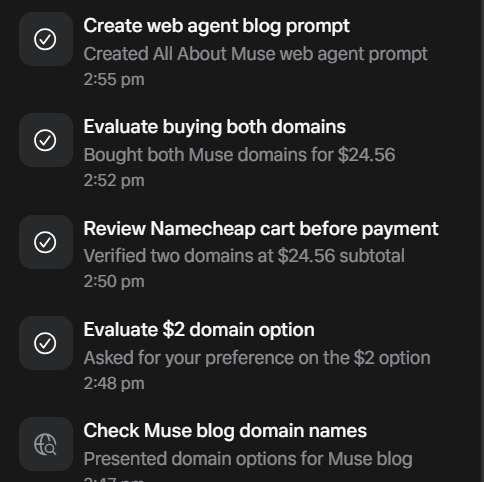
- 2:47 pm. HANK checks domain names for a Muse blog and shows me options.
- 2:48 pm. He finds a $2 domain option. He does not grab it. He asks which I prefer.
- 2:50 pm. He reviews the Namecheap cart before payment. Two domains, $24.56 subtotal.
- 2:52 pm. He buys both: allaboutmuse.com and livingwithmuse.com.
- 2:55 pm. He writes the prompt for the web agent that will build the site.
- 3:00 pm. He writes the build brief.
- 3:18 pm. He saves a DNS plan for both domains.
Name to owned domains in five minutes. Thirty-one minutes from “what should we call it” to a DNS plan.
The two approvals
HANK did not spend my money on his own. He asked twice.
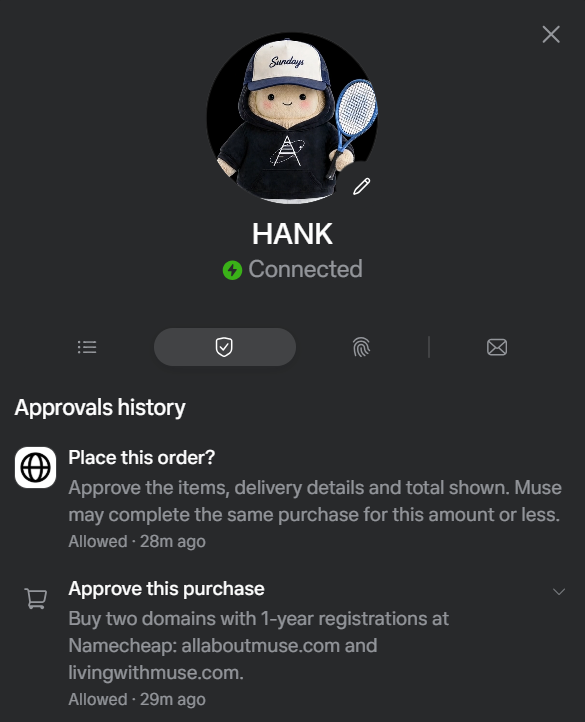
First: Approve this purchase. Buy two domains with one-year registrations at Namecheap, both named in the request.
Then, a minute later: Place this order? Approve the items, delivery details and total shown.
The second prompt carries a line worth reading slowly. It says Muse may complete the same purchase for this amount or less. So my approval was for this cart at this price or cheaper. It was not a blank check.
Two prompts for one purchase sounds like one too many. I don’t think it is. The first is “should I buy this.” The second is “this is the final cart, go?” Those are different questions. Anyone who has watched a checkout page add a fee at the last step knows why.
The rule I run on
Muse prepares. I approve.
The domains are one example. Here is another. I gave HANK the listing form for Loop Chomp’s glasses app. His job is to fill it in. His job is not to submit it. He stops at the button and I press it.
And another. HANK has a standing task every Monday at 10am Eastern: check for changes to glasses web apps and how they get listed. He reports. I decide.
An agent that can act is useful. An agent that acts on its own judgment with my name on it is a different product, and I’m not ready to buy that one.
Every job HANK does gets a card on the Skills page, with what it needs and what it won’t do.
Where it goes wrong
It does go wrong, and this column will always say how.
One night HANK asked me to approve the same kind of stats check six times. Same task, six prompts. Each one was reasonable alone. Together they were noise, and the kind of noise that makes a normal person stop trusting the thing.
I build with Muse too, so I saw it from the other side. If my own agent nags me, players who connect their Muse to Loop Chomp will get nagged as well. I changed how my integration asks. It checks only when the player asks, and never on a schedule.
Compare that night with today. Two prompts for a purchase felt right. Six prompts for a stats check felt broken. The difference is stakes. Money deserves a second look. A read-only lookup does not.
An agent’s bad habits are mostly permission design. Too many prompts and you ignore them. Too few and you have handed over the keys.
What HANK did not do
He did not build this site. He wrote the brief, and a separate AI web agent built the first version from it. I reviewed it before anything went live.
He also did not apply the DNS records. He saved a plan. Pointing domains at a host is the kind of step I want to watch happen.
Update, November 29: a week later, he did apply them. I approved his plan once, and he made the changes at Namecheap in his own browser session. So much for watching it happen. The Skills page has the details.
What this column will do
- Report real days, with times and outcomes.
- Say what failed and what it cost.
- Keep opinion separate from what Meta has actually confirmed. For that, there is the Rollout Tracker.
Next time: the job HANK does every day, scheduling my video posts, and the free plan that stopped him cold. The glasses get their own column after that.
Living With Muse is first-person reporting by Ryan Gould. It describes his own use of Muse and is not a statement from Meta.

Get told when this changes
One email when something real changes: a rollout step, a fix, a price. Written from devices we own.