What Is Muse? Everything Meta's Assistant Actually Does
Quick answer
Muse is Meta's personal AI agent. It launched in the US on September 8, 2026 and it does tasks for you instead of only answering questions. It is free with a usage limit. Paid plans run on the newer Muse Wonder model and cost $16 or $80 a month on the web. Muse is separate from the Meta AI assistant.

Four names get mixed up constantly. Sorting them out answers most of the confusion.
| Name | What it is | Where you meet it |
|---|---|---|
| Muse | A personal AI agent that carries out tasks | The Muse app, muse.ai, WhatsApp, and AI glasses in beta |
| Muse Spark | Meta’s first Muse model family | You don’t pick it. It powers Meta AI and, by most reports, free Muse |
| Muse Wonder | Meta’s newer, larger model | Paid Muse plans. My Power plan says “Runs on Muse Wonder” |
| Meta AI | Meta’s assistant and the app that manages your glasses | The Meta AI app, and inside Meta’s other apps |
Muse is the thing you hand work to. Muse Spark and Muse Wonder are the engines. Which one you get depends on your plan. Meta AI is the older assistant, and its app is still where your glasses get paired and updated.
What Muse does
Meta pitches Muse as a personal agent that works toward your goals without waiting to be asked each time. The difference from a chatbot is that it acts.
At launch, TechCrunch reported that Muse can send emails, book travel, lower bills, fill out forms, build plans, turn recipe reels into grocery lists, send party invitations and make purchases. You give it a job. It plans the steps, does them, and comes back when it needs you.
At Connect on September 23, 2026, Meta added a batch of connectors. The shopping list included Walmart, Best Buy, Sephora, Ulta, Gap and Wayfair, with Shop Pay and PayPal for payment. Meta also listed Instacart, Notion, Granola, GitHub and Box, and said Muse gets its own email address. I went through the directory in my own app and listed every connector I can see.
I run several businesses with a Muse every day. Mine bought the domains for this site. That story is in the Living With Muse column. This page sticks to what anyone can verify.
The timeline so far
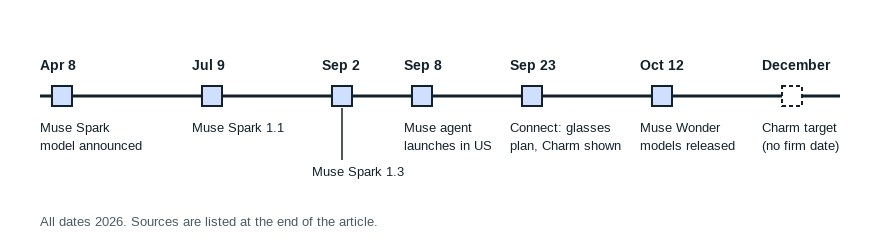
- April 8, 2026. Meta announces Muse Spark, the first model from Meta Superintelligence Labs. Meta calls it a natively multimodal reasoning model with tool use and multi-agent orchestration.
- July 9, 2026. Muse Spark 1.1 arrives. Later that month Meta says Meta AI can make plans, connect to email and calendar apps, and handle tasks.
- September 2, 2026. Muse Spark 1.3 is released for Muse Code and the Meta Model API.
- September 8, 2026. Muse, the agent, launches in the US.
- September 23, 2026. At Connect, Meta says Muse is coming to AI glasses and shows Muse Charm.
- October 12, 2026. Meta releases Muse Wonder and Muse Wonder Full, and says Wonder will reach Muse subscribers first.
How many people use it
On its October 21, 2026 earnings call, Meta said more than 10 million people in the US and Canada had set up Muse in about six weeks, and roughly a quarter use it on any given day. Shopping is the most common use. Why it can’t shop everywhere.
Where Muse runs
At launch Muse was available on the web at muse.ai, in apps for iOS and Android, and in WhatsApp chats, for users in the US. That is from TechCrunch’s launch-day report.
Muse on AI glasses is in beta. It is switched on account by account, which is why your friend may have it and you may not. The Rollout Tracker follows that daily, and this guide explains how to check.
Meta’s newsroom lists Singapore as available as of October 27, 2026. Muse has since reached Canada, Japan, Singapore and Australia. Every country and date is tracked here.
What Muse costs
Muse is free with a usage limit. Two paid plans raise the limit. Here is the Upgrade screen from my own account.
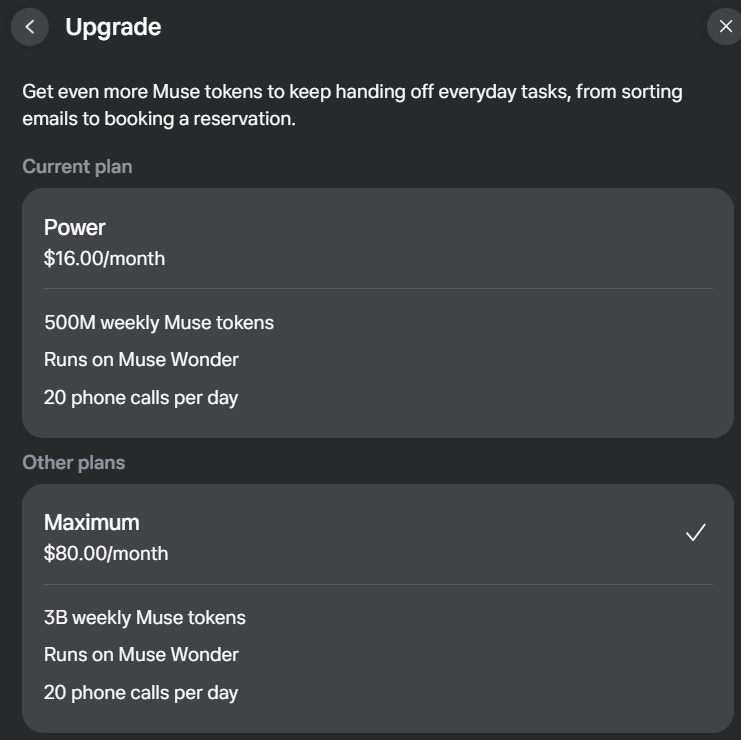
| Plan | Web price | iOS app price | Weekly Muse tokens |
|---|---|---|---|
| Free | $0 | $0 | Limited. Reported as about 100 million |
| Power | $16 a month | $20 a month (reported) | 500 million |
| Maximum | $80 a month | $100 a month (reported) | 3 billion |
The web prices and token counts are from my screen. Both paid plans list “Runs on Muse Wonder” and 20 phone calls per day.
The iOS prices are from press coverage, not my device. Several outlets report the iPhone app charges $20 and $100 for the same plans. The likely reason is Apple’s cut of in-app purchases, though I have not seen Meta say so. If that holds, subscribing at muse.ai on a computer saves you 20%.
The free tier’s size is the one number I can’t show you. Meta’s help page says only that free usage is limited. The 100 million figure comes from launch coverage.
How the limits work
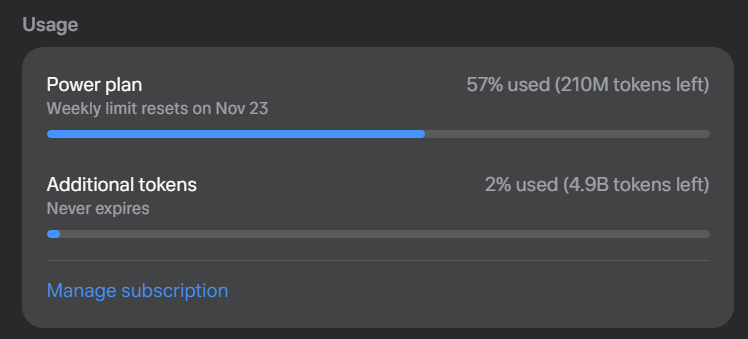
Your plan’s tokens refill every week. Additional tokens are a second pool that never expires. You can buy them, or earn them with a referral code.
Muse and Meta AI are separate
This trips people up on glasses. The Muse app and the Meta AI app are two different apps. Meta’s help page says connecting a service in one does not connect it in the other, and each asks for its own permission.
You still need the Meta AI app for pairing, settings, firmware and your photos and videos. The Muse app holds your conversations with Muse. On glasses, only one of the two assistants is active at a time. The differences are laid out in Muse vs Meta AI on glasses.
The hardware around Muse
- AI glasses. Muse is in beta on Meta’s AI glasses. Start with the complete guide to Muse on glasses.
- Meta Ray-Ban Display and Neural Band. The glasses with a 600 by 600 display in the right lens, and the wristband that controls them. I own both and built a game for them.
- Muse Charm. A pocket device for talking to your Muse. Meta has shown it but has not announced a price. Everything reported so far is here.
FAQ
Is Muse the same as Meta AI?
No. Muse is a personal AI agent with its own app. Meta AI is Meta’s assistant, and the Meta AI app is also where you manage AI glasses. They keep separate connections and permissions.
Is Muse free?
Yes, with a usage limit. Paid plans add more. On the web, Power is $16 a month and Maximum is $80 a month. The iOS app is reported to charge $20 and $100.
What is Muse Spark?
Muse Spark is the first family of AI models from Meta Superintelligence Labs, announced on April 8, 2026. Paid Muse plans now run on a newer model called Muse Wonder.
Can I use Muse on my Meta glasses?
Only if the beta has reached your account. In the Meta AI app, go to Glasses, Device settings, AI assistant. If Muse is an option there, you can switch to it.
Sources
- Meta AI blog, Introducing Muse Spark, April 8, 2026
- Meta AI blog, Introducing Muse Spark 1.1, July 9, 2026
- Meta Newsroom, Meta AI Doesn’t Just Think, It Acts, July 2026
- Meta research blog, Introducing Muse Spark 1.3, September 2, 2026
- Meta research blog, Muse Wonder, October 12, 2026
- TechCrunch, Meta says Muse has over 10M users, with shopping a top activity, October 21, 2026
- FinanceFeeds, Meta’s Muse Hit No. 1 on the App Store in Ten Days, on web and iOS prices and the free allowance, September 2026
- TechCrunch, Meta debuts its Muse AI agent, September 8, 2026
- Meta Newsroom, The Biggest News From Connect 2026, September 24, 2026
- Meta help, How to use Muse on your AI glasses (Beta), read November 22, 2026

Get told when this changes
One email when something real changes: a rollout step, a fix, a price. Written from devices we own.